8090
300-year-old painting stolen by an American soldier during WWII returned to museum_我的网站

A | CHICAGO -- After a stopover in the U.S. that lasted the better part of a century, a baroque landscape painting that went missing during World War II was returned to Germany on Thursday. The FBI handed over the artwork by 18th century Austrian artist Johann Franz Nepomuk Lauterer to a German museum representative in a brief ceremony at the German Consulate in Chicago, where the pastoral piece showing an Italian countryside was on display. Art Recovery International, a company focused on locating and recovering stolen and looted art, tracked down the elusive painting after a person in Chicago reached out last year claiming to possess a “stolen or looted painting” that their uncle brought back to the U.S. after serving in World War II.The painting has been missing since 1945 and was first reported stolen from the Bavarian State Painting Collections in Munich, Germany. It was added to the database of the German Lost Art Foundation in 2012, according to a statement from the art recovery company. “The crux of our work at Art Recovery International is the research and restitution of artworks looted by Nazis and discovered in public or private collections. On occasion, we come across cases, such as this, where allied soldiers may have taken objects home as souvenirs or as trophies of wars," said Christopher Marinello, founder of Art Recovery International. "Being on the winning side doesn’t make it right,” he added.The identity of the Chicago resident who had the painting was not shared. The person initially asked Marinello to be paid for the artwork.“I explained our policy of not paying for stolen artwork and that the request was inappropriate,” Marinello said. “We also know that someone tried to sell the painting in the Chicago art market in 2011 and disappeared when the museum put forth their claim.” But with the help of the FBI Art Crime Team, attorneys, and the museum, Marinello negotiated an unconditional surrender of the artwork.The painting, titled “Landscape of Italian Character,” will now reunite with its counterpart, which shares similar motifs and imagery, according to the museum.The two paintings together form a panoramic scene featuring shepherds and travelers with their goats, cows, donkeys and sheep at a ford in a river. The pair will soon be displayed together for the first time since World War II at the Alte Pinakothek in Munich, according to Bernd Ebert, the museum's chief curator of Dutch and German baroque paintings.Retrieving a long-lost painting "is actually a very rare moment for us,” Ebert said. “It’s exciting.”The Vienna-born artist, Lauterer, lived from 1700 to 1733.When war broke out in 1939, many Bavarian museum collections were evacuated to safe locations in the region, but the Lauterer painting has been missing since the beginning of the war, suggesting the possibility that it had been looted, according to the museum.The Bavarian State Painting Collections first started searching for the painting between 1965 and 1973, but no clues about its location emerged until decades later.Ebert, who flew from Munich to Chicago to retrieve the painting, will carefully bubble-wrap the centuries-old landscape to take it back home, where it will be touched up and restored after an eventful several decades.Luckily, Ebert said, it should fit in his suitcase.___Savage is a corps member for the Associated Press/Report for America Statehouse News Initiative. Report for America is a nonprofit national service program that places journalists in local newsrooms to report on undercovered issues.。
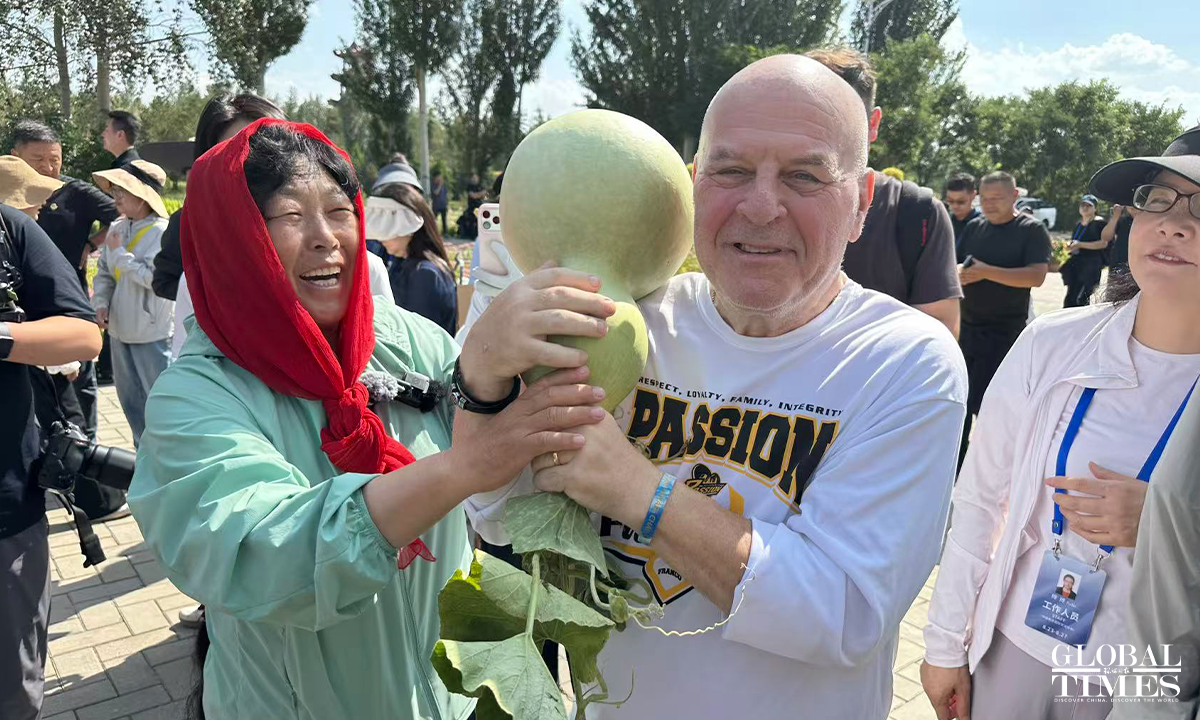
Yin Yunzhen introduces to Sakolsky the harvest from the once-barren wasteland. Photo: Lin Xiaoyi/GT
On Monday afternoon, American teacher Ronald Sakolsky visited the homeland of Chinese desert fighter Yin Yuzhen in Uxin Banner of Ordos, Inner Mongolia Autonomous Region. This was a place the American man had visited in 2000 and it has completely changed since then.
In 1999, Sakolsky, a teacher in a China-US education exchange program, was touched by a report on Yin and her husband's afforestation efforts in the harsh wilderness of Mu Us Desert, and raised $5,000 to support her green cause. During that visit, they took pictures - in front of the sunken pit where the Yin couple once resided and in the barren land with a finger-thin sapling they had just planted against a backdrop of dust and bare earth.
What has the $5,000 changed?
On Monday, they came to the Sakolsky forest - a permanent tribute honoring Sakolsky's early contribution to the region's ecological revival - and replicated the vintage pictures, standing in front of a pit that has long been abandoned and beside a newly planted sapling. This time, however, there are bushes and trees in the background.
This contrast not only witnessed their friendship across time and the Pacific Ocean, but also showcased a promise Yin has kept for 27 years and a green dream that has been made possible through generations of joint unwavering efforts from Yin, her husband and countless other sand fighters.
Homecoming with family cooking
Yin hosted Sakolsky on Monday at her home, filling the air with the aroma of home-cooked meals during their long-awaited reunion. Watermelons were served along with other fresh fruits and vegetables, all harvested locally. Yin told the Global Times earlier that she learned the English word "more" to persuade him to eat more.
In 1999, Yin had few options for showing her hospitality, so she cooked a bowl of plain noodles for Sakolsky. Now, the harsh wasteland has transformed into a vibrant green oasis, thanks to unwavering afforestation efforts.
In the courtyard, the Global Times reporter saw Yin grinning from ear to ear with pride as she introduced the produce from the farmland - green pepper longer than a palm, a bottle gourd even bigger than Yin's head, and bags of foxtail millet packaged with the assistance of Yin's grandchildren, who are proud of the family's generations of commitment to green causes.
During a tour of Yin's home, Sakolsky was impressed by the beautiful house with its green courtyard, saying "You deserve every centimeter of this house." Throughout the visit, he repeatedly praised Yin's hands, which the desert fighter and model worker used to change both the land and her own life through arduous work.
The $5,000 Sakolsky donated in 1999 was equivalent to three years' income for Yin's entire family at the time. Today, that money has grown into more than 50,000 trees.
But Yin's journey did not stop there. Over the following decades, with the support of China's growing ecological restoration policies — including subsidies for afforestation and compensation for forest managers — she transformed the barren land into a productive family forest farm. Her success has inspired many others in the region to take up tree planting and sand control, transforming what was once a desperate struggle into a sustainable livelihood.
From the sandy hollow where the Yin couple lived in in 1985 and the earth hut they resided in until 1993, to the solid brick house Sakolsky saw when he last visited, and the two-story house the big family now lives in, the change in living environment is a clear example of ecological dividends.
Uxin Banner lies in the heartland of the Mu Us Desert. The desertification rate was over 90 percent in the 1950s and forestation coverage was merely 7.2 percent as of 1980. Now, the forestation rate has increased to 33 percent, while plantation coverage has expanded to 85 percent, per official data.
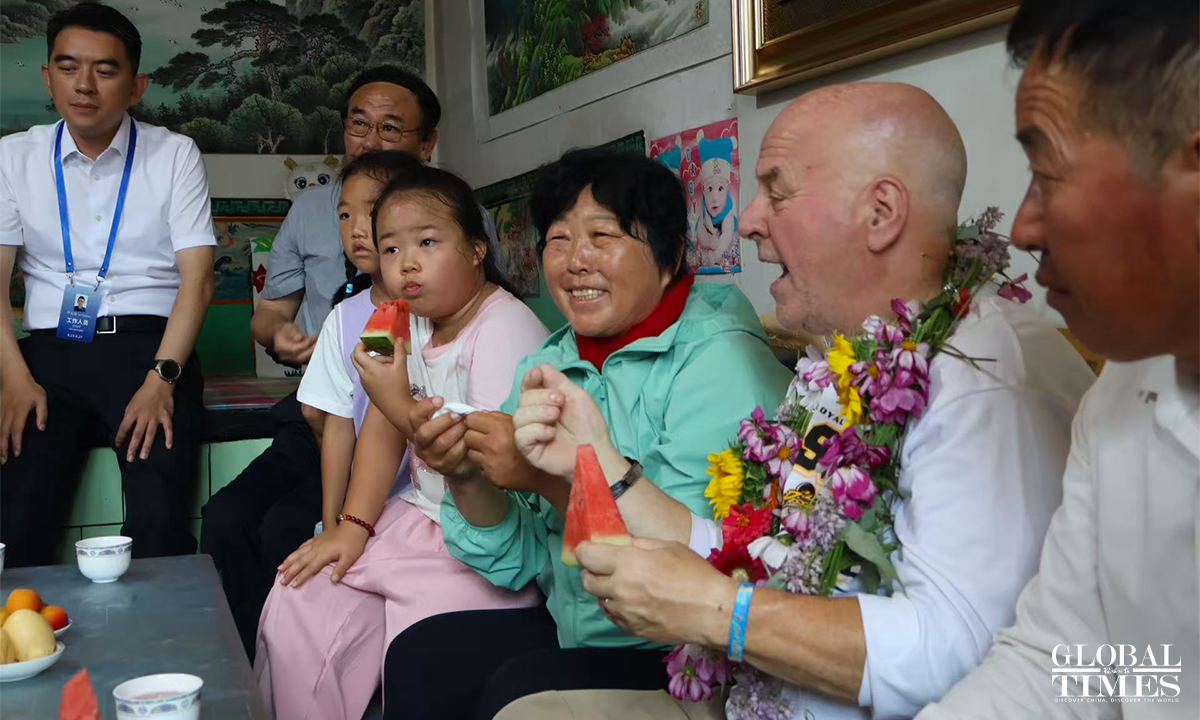
Sakolsky and Yin enjoy watermelons and other fruits at Yin's home. Photo: Lin Xiaoyi/GT
Carry on the greenness, kindness This miracle would have been impossible without numerous people like Yin, long-term systematic planning and scientific governance.
Chen Ziliang, an expert from the local forestry and grassland bureau, said that Mu Us Desert's sand‑control journey has evolved from collective afforestation to contract desert‑reclamation, moving beyond the simple goal of "keeping trees alive" to restoring vegetation based on water‑resource conditions.
Putting the idea of "lucid waters and lush mountains are invaluable assets" into practice, Uxin Banner no longer views "greenness" and "growth" as an either‑or proposition. On restored sandy lands, the under‑forest economy, eco‑agriculture and eco‑tourism have flourished. Sand‑fixing shrubs are now processed into animal feed and biomass fuel, and local authorities are exploring photovoltaic‑powered desert control, the Global Times learned.
Sand control is no longer just about keeping sand away; it's a development approach that guarantees a greener and better living environment alongside a booming economy and increasing incomes.
On Monday afternoon, when Sakolsky finally stepped into the forest named after him, this American teacher witnessed the Chinese woman's perseverance and commitment to her promises. The $5,000 donated without expectations has grown into a thriving forest of around 50,000 trees.
"A promise is a promise. Ms. Yin fulfilled her promise," Sakolsky said. After 27 years, the wasteland is green, and Sakolsky and Yin are "brother and sister."
"This is the answer to how we guide young people: We must teach them love and perseverance. We need to show young people photos of Ms. Yin planting trees, digging the soil with her bare hands," Sakolsky remarked while packing a jar of sand. He said he planned to bring it back to the US, telling his grandchildren it is not just a jar of sand, but "a jar of love."
Sakolsky told the Global Times earlier that the younger generation only knows about the dust-covered landscape from photos and stories of the elderly. It is important to tell them how the greenness is achieved, and how every single person can contribute to making an extensive forest in the harshest environment.
"I see where China and America can work together. I see it, so I will not quit. She [Yin] never quit. 'Quit' is not in her vocabulary," Sakolsky said with emotion on Monday.
"Chinese and Americans can be family. We can get over the differences if we focus on the similarities... If we focus on our similarities and not our differences, we can solve the problems."
At the end of Monday's schedule, Yin and Sakolsky planted another sapling together, just as they did about three decades ago, but in a completely different landscape.
This new sapling carries on the story of not only greenness through generations of joint efforts, but also kindness across the Pacific Ocean.
。
Current article:http://v66x.zhanggengsenchaiweikeng.cfd/qdy/20260826/6643.html
Published on:16:59:34

 微信
微信 移动端
移动端