吭哧吭哧跑步,或许不如在手机上点份「假外卖」掉秤快。

B |
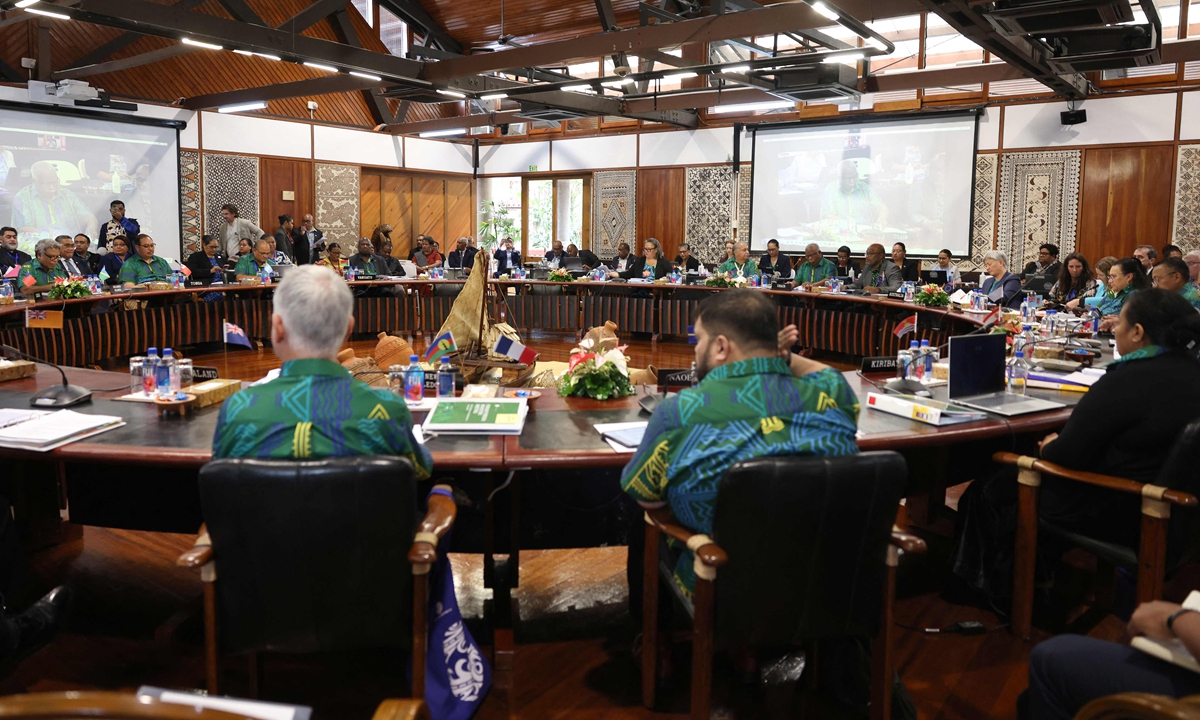
Foreign ministers and top diplomats of the Pacific Islands countries attend a meeting of the Pacific Islands Forum (PIF) in Suva, Fiji, on August 7, 2026, ahead of the full leaders meeting scheduled for September 2026 in Palau. Photo: VCG
As foreign ministers and senior representatives from Pacific nations convened in Suva for the Pacific Islands Forum (PIF) to discuss key regional issues, New Zealand's foreign minister reportedly pushed to secure a joint statement condemning China's missile tests in July, however, his effort ultimately fell flat. A Chinese expert described the outcome as a clear rebuke to Canberra and Wellington's ingrained habit of speaking for the Pacific, saying the two countries must come to terms with a shifting reality: Pacific Island states are increasingly unwilling to let Australia and New Zealand dictate who their friends, foes and perceived security threats should be.
Pacific Island foreign ministers failed to agree on Friday to a joint response to China's missile launch in July, with further discussions expected at the Pacific leaders meeting at the end of August, said New Zealand Foreign Minister Winston Peters, according to Reuters.
According to a report from Radio New Zealand, there has not been a unanimous statement from Pacific nations about China's test-launch in July, and Peters said New Zealand had been pushing for one. Peters claimed that the Pacific missed an opportunity not to issue a joint statement soon after China's launch.
Australia's Foreign Minister Penny Wong said before the meeting that she hoped China took note of the "very clear response" already sent from the Pacific about the test, according to AFP.
Peters' push for a joint PIF statement on China's missile tests, together with Wong's remarks, are less about technical security concerns than an effort to turn their own anxieties about China into a regional agenda and pressure Beijing under the forum's collective banner. His description of Pacific Island countries' refusal to single out China as a "missed opportunity" also reveals little respect for their independent judgment, Chen Hong, director of the New Zealand Studies Centre, East China Normal University, told the Global Times.
The result is a clear rebuke to Canberra and Wellington's long-standing habit of arrogantly "speaking for" the Pacific, as island states are increasingly unwilling to let Australia and New Zealand decide who their friends, foes or security threats should be, said Chen Hong.
The Chinese People's Liberation Army Navy said on July 6 that one of its strategic nuclear submarines successfully launched a strategic missile toward relevant high seas of the Pacific Ocean, which landed precisely within the designated waters. China notified relevant countries in advance of the test launch, a move that demonstrates the openness and transparency of the Chinese armed forces, Chen Xi, a spokesperson for the Ministry of National Defense, said at a press conference on July 7.
Chen Hong also noted that Peters' recent China-related rhetoric has become increasingly populist and hawkish as elections approach in New Zealand. "Such an approach risks undermining New Zealand's long-standing reputation for pragmatic, independent, and rational diplomacy," Chen Hong said.
In July, during a parliamentary debate on New Zealand's Covid-19 pandemic response, Peters, who is also leader of the populist New Zealand First party, told a Chinese-born lawmaker to "go back to your own country" while mocking his English proficiency. His remarks drew wide criticism in New Zealand.
Yet Australia and New Zealand continued to amplify missile-related issues and great-power rivalry, pushing the "China threat" narrative to the center of the regional agenda while sidelining the priorities that matter most to Pacific Island nations, said Chinese analysts.
Chen Hong noted that for island states, the most urgent concerns are not geopolitical competition but everyday challenges: climate change, energy security, development financing, infrastructure and economic resilience. By shifting the focus from these concerns to strategic rivalry among major powers, Australia and New Zealand risk distorting the region's real priorities and undermining the aspirations of Pacific Island countries.
According to an introduction on the forum website, "The Forum's Pacific Vision is for a resilient region of peace, harmony, security, social inclusion and prosperity, so that all Pacific people can lead free, healthy, and productive lives."
At the opening of the meeting, Rick Houenipwela, foreign minister of the Solomon Islands and chair of the meeting, said that the Pacific's agenda must continue to be "conceived by the Pacific, shaped by the Pacific and only by the Pacific," according to Reuters.
Chen Hong said Pacific Island nations have made their position clear: differences with China do not mean signing up to the strategic agendas of Australia and New Zealand. A growing number of island countries refuse to be trapped in the black-and-white binary choice of siding with either China or the West.
If Canberra and Wellington keep pushing rhetoric beyond the regional consensus, they risk undermining the very institution they claim to support. The PIF's strength lies not in issuing confrontational statements, but in preserving Pacific unity. Turning that consensus into a tool for pressuring China would erode the forum's cohesion and weaken its central role in the region, said Chen Hong.
。很多年轻人都有过这样的体验:饥肠辘辘的深夜,躺在床上划拉外卖软件,纠结是点烧烤、炸鸡还是小龙虾。而外卖一到,大快朵颐之后,又陷入后悔:「我到底为什么要吃这么多?」「为什么又花冤枉钱点外卖?!」如果有一种办法,既能过足挑外卖的瘾,又能不花一分钱、不摄入任何卡路里,那该有多爽?一个名为「外卖不会来」的App,就靠着「假外卖」业务,号称满足了全球用户近一百万次「进食欲望」。不管饿不饿,点开「外卖不会来」界面,都会忍不住流口水。实时热门菜单上,牛肉麻辣烫、锅包肉、黄油盐面包……全是此时此刻全球网友共同「点」出来的爆款。

C | 在这里,你不仅能像平时一样挑选菜品,花钱多加一份肉,备注「微辣不要葱」;还能使用膨胀后的优惠券,实时监督后厨有没有现炒出餐。

D | 唯一的区别在于——你永远也不会收到这份外卖。且界面上变化的,只有「累计节省金额」及「累计减少热量」。图源:外卖不会来以一份经典的芝士汉堡加薯条套餐为例,算上配送费,「假外卖」不仅能省下45元,更能减少约1270卡路里的摄入。而同样的热量放在跑步机上算,至少得慢跑40分钟才能消耗掉。只靠「假外卖」就能减肥吗?科学家们给出的答案是:真的可以。在心理学中,这种操作被称为「预期性奖励」。研究表明,掌管快乐与欲望的多巴胺,主要在「想要」和「期待」的过程中大量分泌,而不是真正「得到」之后。换句话说,比起真正吃进嘴里的快乐,挑菜品、凑满减、点击下单的过程,就已经足够让大脑产生对食物的满足感,从而大幅降低现实中的进食欲望。图源:外卖不会来正如「外卖不会来」在网页版界面中写道:「一份真正的凌晨一两点的外卖订单,总会伴随着一丝遗憾,而虚假的订单则毫无遗憾可言。当你摆脱了享受后的内疚感,剩下的东西,竟意外地接近纯粹的乐趣。」看中了这种「赛博心理代偿」的,远不止假外卖这一个赛道。在替尔泊肽等药物广泛应用于体重管理的今天,一些商家已经开始把这套多巴胺玩法用在了健康管理上。类似「好大夫在线」的韩国线上诊疗平台Doctor Now就推出了一款名为「心灵胶囊(Mindjaro)」的虚拟减肥针应用,谐音来自替尔泊肽(Mounjaro)。用户只需要拿起手机对准自己的肚子,屏幕上就会播放一段药物注射动画,注射完成后还会贴心地弹出提示:「你的食欲已经消失了。

E | 」图源: Doctor Now虽然听上去这个功能有些啼笑皆非,但对于想要尝试注射类体重管理,但又碍于身体顾虑或经济困境的人来说,「假减肥针」确实提供了有效的心理慰藉价值与尝试窗口。值得一提的是,不管是不用花钱的外卖,还是不用挨一针的减肥,这些软件的下载与使用基本都是免费的。流量之下,对于开发团队而言,它们的商业价值,还在于深度洞察大众的健康焦虑,为后续的变现通道开路。

F | 比如,「外卖不会来」就可以根据用户在不同菜品上的停留时长,衍生出消费数据分析与广告投放;Doctor Now则可以依托「假减肥针」,降低新用户尝试的心理门槛,让更多人愿意了解并接触平台上真实的医疗资源。而这些琐碎的日常细节之所以能被做成产品,归根结底还是离不开大众对于健康生活的复杂情绪。一边是对健康、好身材的追求,另一边是对食物的欲望、对现实生活的疲惫。

G | 甚至,使用这些产品的人比谁都清楚,自己的行为不过是在「欺骗大脑」。但对于身心俱疲的当代年轻人而言,他们所需要的,或许不是一步到位的解决方案,而是在变健康路上的喘息时刻。

H |